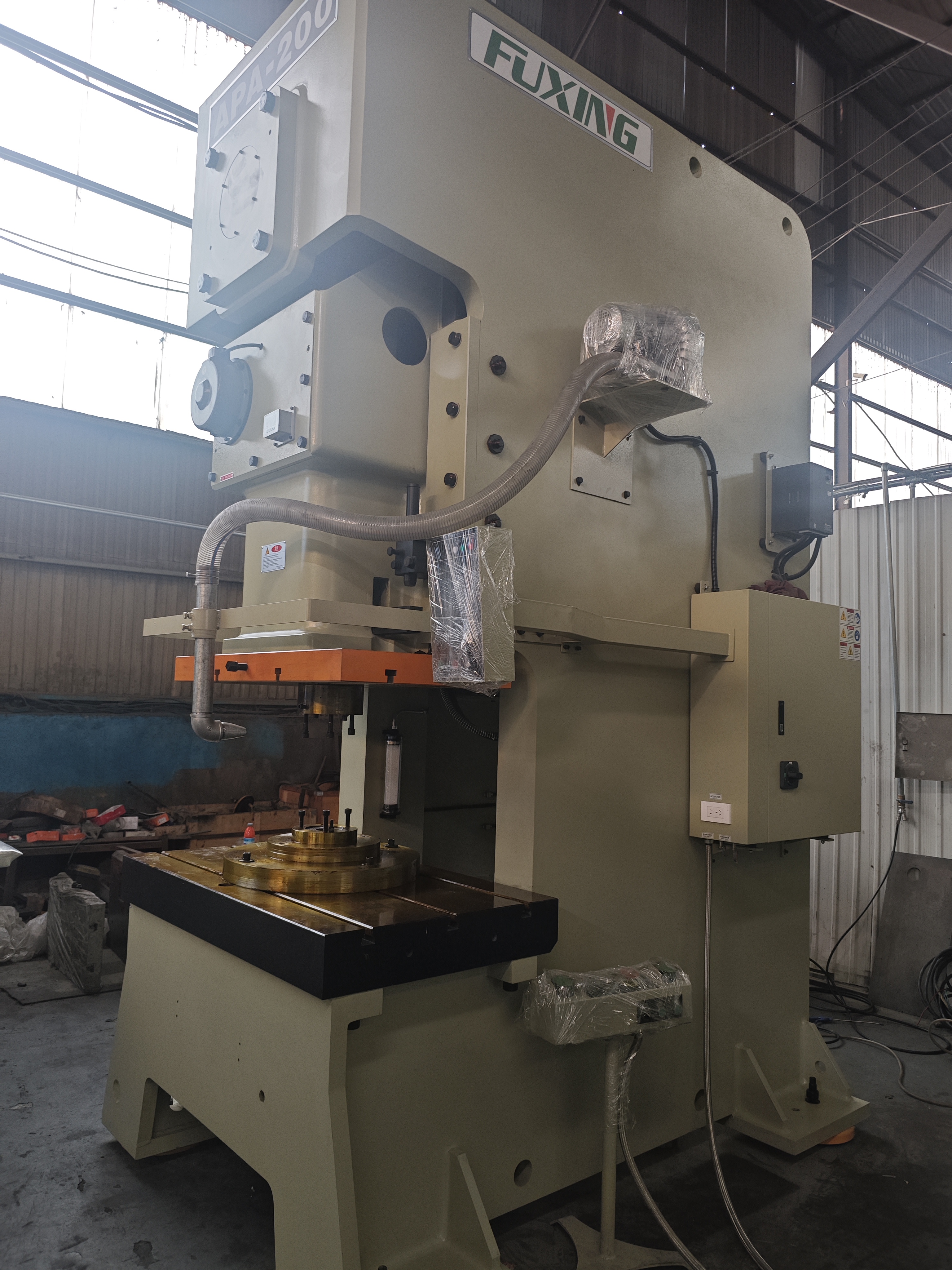
Welcome to Shandong Fuxing Machinery Co., Ltd.
The Power Transmission Master Inside a Pneumatic Press: Why Is the Crankshaft So Important?
When a pneumatic press is running at high speed, what operators see is:
“The punch moving up and down rapidly.”
What they hear is:
“Clack! Clack! Clack!”
But inside the machine, there is a key component constantly rotating, accurately converting the motor’s power into stamping force.
It is the:
Crankshaft.
If a press is compared to a powerful athlete, the crankshaft is its “core strength.”
Without a strong core, even the strongest athlete cannot release power effectively.
01 Why Does a Pneumatic Press Need a Crankshaft?
When people first hear about a pneumatic press, they often ask:
“Does a pneumatic press use air pressure to push the punch directly?”
Actually, it does not.
Most industrial pneumatic presses are essentially mechanical power presses.
Their power transmission process is:
Motor → Flywheel → Pneumatic Clutch → Crankshaft → Connecting Rod → Slide → Die
Compressed air is mainly used to control:
Clutch engagement
Brake operation
The actual mechanical movement conversion is completed by the crankshaft.
02 The “Magic” Job of the Crankshaft
What is a motor best at?
Rotating.
But what does a press need?
Up-and-down movement.
This is where the crankshaft becomes the translator.
It converts:
Rotary motion
into:
Linear reciprocating motion.
So:
One rotation of the crankshaft,
creates one complete up-and-down movement of the slide,
and completes one stamping cycle.
Simple, efficient, and reliable.
That is why mechanical presses have remained widely used in manufacturing for decades.
03 Why Is the Crankshaft Not Straight?
When people see a crankshaft for the first time, they often wonder:
“Why is this shaft bent? Was it made incorrectly?”
The answer:
No.
It is intentionally designed this way.
The offset structure of the crankshaft determines:
Slide movement distance
Stamping stroke
Power transmission efficiency
Without this special design, the press would not be able to perform its stamping motion.
04 What Challenges Does a Crankshaft Face Every Day?
A press may operate continuously for many hours every day.
The crankshaft must handle:
✔ High-speed rotation
✔ Heavy impact loads
✔ Repeated working cycles
✔ Precise mechanical coordination
Therefore, a high-quality crankshaft requires:
High Strength
Usually manufactured from high-quality alloy steel and heat-treated to improve fatigue resistance.
High Precision
Because crankshaft errors can affect:
Stamping accuracy
Die life
Machine stability
A crankshaft is not simply a component that “can rotate.”
It must perform every rotation with precision and reliability.
05 The Crankshaft Determines the Character of a Press
Different press capacities require different crankshaft designs.
Small presses are suitable for:
Washers
Small hardware parts
Electronic components
Large presses are suitable for:
Automotive parts
Thick sheet metal stamping
Large formed components
The higher the tonnage,
the greater the responsibility carried by the crankshaft.
06 The Hidden Hero Behind Every Stamping Operation
In a factory, people usually focus on:
“How many tons is the press?”
“How many strokes per minute?”
“What is the accuracy?”
But few people notice the crankshaft working continuously inside the machine.
It has no display.
No buttons.
No complaints.
It simply performs the same mission every day:
Deliver power accurately and complete every stamping cycle reliably.
Conclusion
A high-performance pneumatic press is not powered only by a strong motor.
Its stable and efficient stamping performance comes from the precise cooperation of every internal component.
And the crankshaft is one of the most important power transmission cores.
From power transmission to precision stamping, every component matters.